Last updated November 18, 2026

Free written scope consultation - allowances, timeline, and change-order rules on paper before a single trade is scheduled
Driveway & Pavers Maintenance Checklist for Burbank Homeowners
A paver surface that looks fine in October can be cracked, lifted, and channeling water toward your foundation by March. Burbank’s seasonal swing is the culprit: months of hard UV and dry Santa Ana wind cycles followed by a short, intense rainy season that dumps water faster than most driveways can shed it. We’ve watched homeowners spend two to three times the original installation cost on repairs that a $400 to $900 yearly maintenance routine would have prevented. This guide walks you through the exact checklist we use on Burbank properties – sealing timing built around our UV index, joint sand refill cadence, winter drainage inspection, and which local materials actually hold up.
Quick Answer
For a driveway or paver surface in Burbank, plan on three maintenance touchpoints per year: a joint sand inspection and refill in early spring after the rainy season ends, a full reseal every 24 to 36 months timed to the dry season rather than a calendar year, and a drainage and edge-failure walk-through before the first significant rain in late fall. Skipping any one of these lets Burbank’s UV exposure and winter runoff work together to loosen, shift, and crack the surface.
Styles & brands we work with
- Kitchen remodeling
- Bathroom remodeling
- Home additions & ADU
- Roofing
- Windows & doors
- Driveway & pavers
- Fence
Table of Contents
- Why Burbank’s Climate Breaks Pavers Faster Than the Manufacturer Charts Say
- Sealing Schedule Built Around Burbank’s UV Index and Dry Season
- Santa Ana Wind Debris and Joint Sand Erosion: The Refill Cadence That Prevents Shifting
- Winter Rain Drainage Inspection Checklist
- Spotting Edge Failure and Base Settlement Before You Need a Full Reset
- Which Paver Materials Hold Up in Burbank – and Which Ones Sold Locally Don’t
- The Burbank Seasonal Maintenance Calendar
- What Driveway and Paver Maintenance Costs in Burbank
Why Burbank’s Climate Breaks Pavers Faster Than the Manufacturer Charts Say
Paver manufacturers publish maintenance guidance built for national or global averages. Burbank doesn’t live in those averages. In our experience, that gap is where most premature driveway failures start.
The first factor is UV. Burbank sits in a basin that regularly pushes the UV index above 10 from May through September – the “extreme” range where polymeric joint sand, sealers, and even the pigment in lower-grade pavers break down faster than a generic maintenance cycle anticipates. A standard “reseal every 3 to 5 years” recommendation is written for a climate with roughly half our solar load.
The second factor is the Santa Ana wind cycle. When those dry offshore winds run through the Verdugo Mountains and across Burbank in fall, they carry fine grit from the hills, chaparral, and adjacent landscaping. That grit sandblasts the surface of the pavers and works its way into joints, grinding the sand bed down from the inside. What looks like normal wear on a paver edge in a Burbank driveway is often grit erosion, not traffic.
The third factor is our rainfall pattern. Burbank gets an average of about 17 inches of rain, but it arrives in a handful of concentrated storms between November and March. When a dry, compacted joint system suddenly takes on that volume, water either runs off the way it should or finds the path of least resistance: under the pavers, into the base, and toward the lowest point on your property, which is often the garage slab or foundation line.
Those three forces – UV, wind abrasion, and flash rainfall – create a specific failure sequence. The surface dries and oxidizes, joints open, grit and wind-driven debris fill the gaps, water gets in during the first storm, the base softens just enough to allow movement, and the paver edges begin to heave. Most Burbank homeowners catch this at step 4 or 5, when a full reset is already on the table. This checklist is built to catch it at step 2 or 3, where you’re still in maintenance territory.
Sealing Schedule Built Around Burbank’s UV Index and Dry Season
Forget the “once a year” rule you’ll find on most paver manufacturer sites. A Burbank driveway needs resealing whenever the sealer has lost its protective film, and in our climate that means every 24 to 36 months – not every spring.
Here’s the test we use on-site: pour a cup of water onto a clean patch of pavers in full sun and time how long the water beads. If it beads and runs off for more than 30 seconds, the sealer is still doing its job. If the water darkens the paver surface within 10 seconds, the sealer is gone. That test is more reliable than any calendar date, because Burbank’s UV exposure changes from block to block depending on shade from neighboring trees, neighboring buildings, and slope angle.
Two sealing windows work best in Burbank, and both are defined by weather rather than a holiday:
- Mid-April through mid-June. The rainy season has typically ended, daytime temperatures sit reliably in the 70s and 80s, and the UV index hasn’t yet peaked. Sealer cures evenly in this window.
- Late September through late October. A second viable window before the first storms, but you must watch the Santa Ana forecast. Sealer applied while those dry winds are running can cure unevenly and leave a streaky surface.
What you don’t want to do is seal between November and March. Even on a sunny week, the paver interior retains moisture from the last storm, and trapped moisture under a sealed surface is one of the leading causes of hazing and efflorescence in Burbank driveways. That white chalky residue you see on pavers along Magnolia Park blocks is nearly always trapped season moisture, not a bad paver batch.
Finally, the sealer type matters. In Burbank’s UV range, an acrylic-water-based sealer is a reasonable standard choice. A penetrating siloxane sealer holds up slightly better against UV for driveways with heavy sun exposure all day. A solvent-based high-gloss sealer is the weakest choice for our climate: it flashes off too fast in the dry heat, tends to yellow under UV within 18 to 24 months, and often requires the same labor to strip it as the original seal cost.
Santa Ana Wind Debris and Joint Sand Erosion: The Refill Cadence That Prevents Shifting
Joint sand is what locks a paver system together. When it drains out – and in Burbank it drains out faster than almost anywhere in Southern California – pavers can shift, edge pieces can loosen, and the whole surface begins to chatter under tire load.
The Santa Ana winds are the single biggest driver of sand loss in a Burbank driveway. Those offshore gusts routinely hit 30 to 50 mph in the fall and winter, and they carry fine dust from the Verdugo foothills that acts like sandpaper in the joints. Add wind-driven grit from the landscaping on the Rancho Equestrian and hillside properties, and you’ll often find the joints on the windward edge of a driveway are noticeably eroded four to six months before the sheltered side shows any wear at all.
Here’s the refill cadence that keeps Burbank pavers locked in place:
- Post-rainy-season inspection (March or early April). Walk the driveway with a stiff broom and note any joints where the sand is more than 1/4 inch below the paver chamfer. Refill those joints with polymeric sand before the dry season.
- Post-Santa-Ana-season inspection (late November through December). After the first major wind cycle passage, check the windward edge and any perimeter rows against the garage slab or curb. These areas lose sand fastest.
- Spot refills as needed. If a joint is visibly empty after a storm, refill that section before the next rain. Small spot refills cost a fraction of a full joint reset.
One detail most homeowners miss: sand type matters. Standard washed concrete sand is fine for a fresh installation but it doesn’t hold up as well in Burbank’s UV, because it doesn’t bind. Polymeric sand that activates with a light mist of water is the better choice for refills. It resists wind erosion better and moves the refill cadence from every year to every two years, which is exactly what Burbank’s wind cycle calls for.
If you’re noticing pavers that rock slightly underfoot after a wind event, that’s early shifting, not a reset emergency – yet. A proper joint cleanup and polymeric sand refill performed in the same week will usually lock the field back down. Wait two or three more cycles and the base compaction underneath the shifting paver will erode too, and now you’re resetting a grid instead of refilling a joint.
Winter Rain Drainage Inspection Checklist
Burbank gets about 17 inches of rain per year, but the math that matters is that roughly 80% of it arrives in storms that deliver half an inch to an inch in a single day. That’s when the driveway either drains correctly or becomes the pipe that sends water to your foundation.
Run this inspection every October or the first week of November, before the first significant storm:
- Confirm the fall line. A standard driveway needs at least a 1% to 2% slope away from the garage slab. Stand at the top and watch where water flows when you hose the surface lightly. If you see ponding more than 1/4 inch deep anywhere in the field, or water tracking back toward the garage, the slope has been lost and needs correction.
- Check every joint for sand level. Open joints invite water into the base. Any joint more than 1/4 inch low gets refilled before the first storm.
- Clear the paver drain channel. French drains, channel drains at the garage apron, and grates between the driveway and the street all need to be cleared of leaf litter and wind debris. In Burbank, eucalyptus and ficus debris alone can clog an apron drain in a single week.
- Inspect edge restraint. The plastic or metal edge restraint running along the sides is the wall that keeps the whole paver field from spreading. A cracked edge piece or a popped stake allows the field to creep outward and the joints to open.
- Look at the low corners. Every paver driveway has a low point, and in Burbank that’s usually the corner nearest the side yard. Check for standing water and any sign of soil washout under the edge.
- Inspect the driveway-to-street transition. Burbank’s hillside and canyon blocks often have a steep apron where water accelerates. Any paver lifting at the transition signals a broken base layer or a blocked municipal drain, both worth resolving before the rainy season.
- Confirm the catch basin grate is seated. If your driveway drains to a street-side basin, check that the grate hasn’t settled. A settled grate invites the drain to clog during the first storm.
Please don’t try to correct base settlement or edge restraint repair yourself. Those are load-bearing elements, and an improperly repaired edge fails faster than an unrepaired one. A trained professional can diagnose the failed layer in a short visit and give you a written scope before any work begins.
Spotting Edge Failure and Base Settlement Before You Need a Full Reset
Edge failure is the single most expensive kind of paver repair, and Burbank’s seasonal swings make it more likely than most homeowners realize. A full reset of a driveway can run three to five times the cost of a targeted edge repair done early.
The failure sequence almost always runs in this order:
- Step 1: Edge sand loss. The sand between the perimeter pavers and the edge restraint drains out, and the edge paver begins to rock slightly. This stage costs almost nothing to fix.
- Step 2: Edge restraint movement. The plastic or metal strip that holds the field in place begins to tilt or pop away from the base. You’ll notice a hairline gap along the outside of the paver row. This is still a repair-only stage.
- Step 3: Base washout. Water has run under the edge and eroded the compacted base course. When you step on the edge paver, it drops 1/8 to 1/4 inch and springs back. This needs to be addressed now, before the field widens.
- Step 4: Field movement. The surrounding rows begin to open along the shifted edge. Once you can fit your fingertip in the joints of three or more rows, a partial reset is on the table.
- Step 5: Full reset. Multiple edges fail simultaneously and the base course under the field has lost compaction across the whole surface. This is the stage where you’re paying for the entire installation again.
In Burbank, base settlement is easiest to spot in the hillside neighborhoods – parts of the Verdugo Woodlands and the blocks that climb into the foothills above Glenoaks – because differential slope and drainage put more pressure on the base course than a flat lot in Magnolia Park does. If you live on a slope, check the downhill edge of the driveway twice a year instead of once.
A tell we’ve seen repeatedly: after the first storm of the season, walk the perimeter slowly in flat shoes and press your heel along the edge pavers. If any edge paver moves noticeably and doesn’t spring back, the base has softened and the repair is now in Stage 3, not Stage 1. Book the inspection in the next six weeks and the repair typically stays in the hundreds of dollars rather than the thousands.
Which Paver Materials Hold Up in Burbank – and Which Ones Sold Locally Don’t
Material choice matters more in Burbank than in most of the country, because UV exposure here pushes pigment and surface finish harder than the manufacturer’s data sheet assumes. Here’s how the common paving options actually perform in our climate:
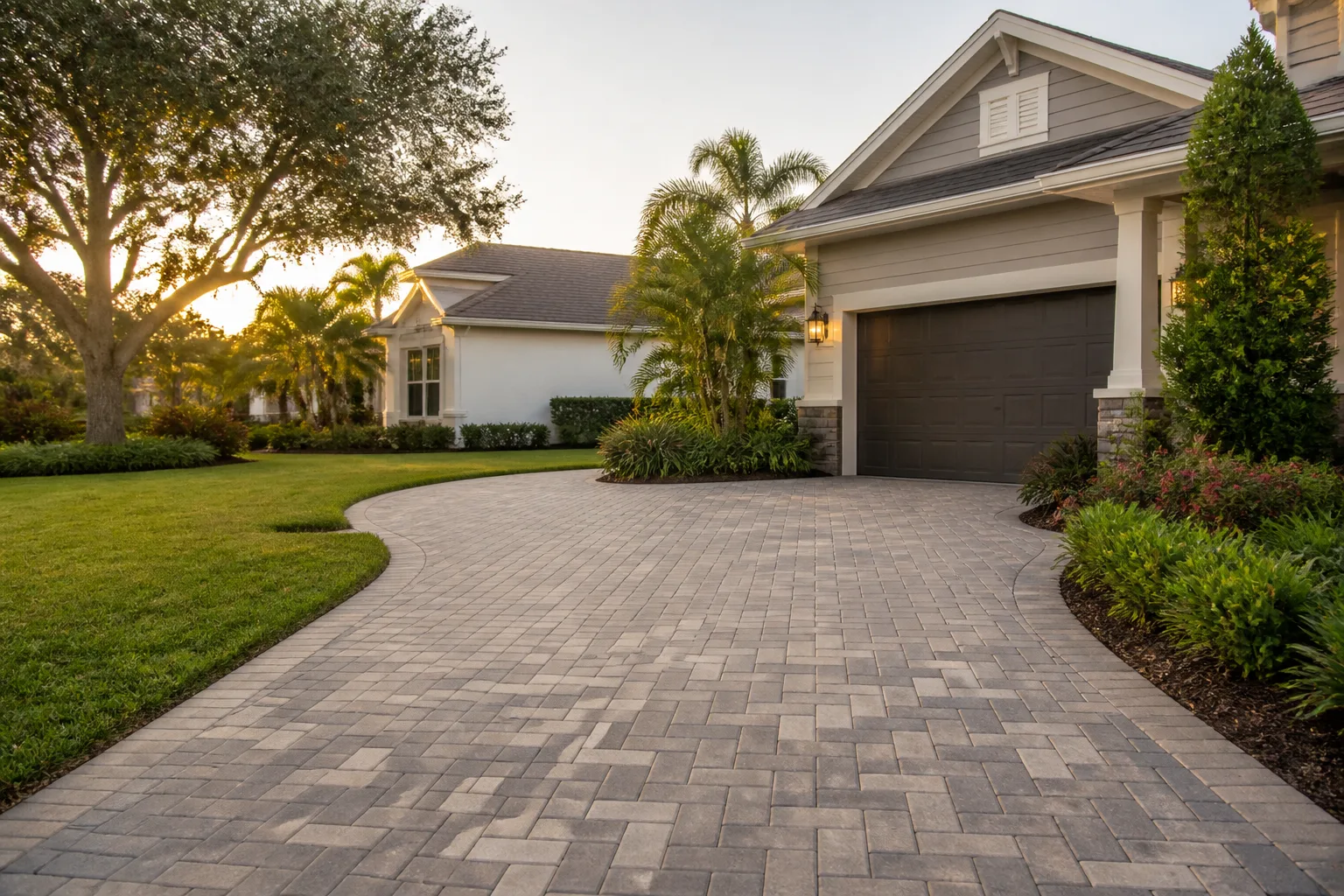
- Concrete pavers (interlocking). The most bulletproof choice for Burbank driveways. Interlocking concrete pavers from a quality manufacturer – the kind that come with a written color-fade warranty of 10 years or more – hold up to UV, wind, and traffic better than almost anything else. Color can still fade slightly over 15 to 20 years, but the surface remains structurally sound.
- Clay brick pavers. Excellent for a driveway apron or a decorative border, and the color is truly through-body so it never fades. The catch is that clay pavers are more brittle under point loads (a dropped heavy item, a jack stand), so we usually don’t recommend them for full driveways used by heavy vehicles.
- Natural stone (flagstone or travertine). Beautiful for a Burbank front walkway or patio, but a poor choice for a driveway that sees regular car traffic. The softer stones stain from oil drips and chip along the edges within five to seven years of traffic. They also absorb Burbank’s intense summer heat and can reach surface temperatures that make bare feet painful.
- Poured concrete with a stamped or exposed-aggregate finish. Often marketed as a paver alternative. These look great for the first three to five years, but Burbank’s summer heat and winter rain cycles create hairline cracks that become full cracks. Surface repairs are visible because the finish can’t be matched.
- Permeable pavers (open-graded). Worth considering if your property has poor drainage to the street. They handle Burbank’s flash-rain storms well, but they need a more disciplined joint-sand refill cadence – the open joints that make them permeable also make them the fastest to shed sand in the Santa Ana wind cycles. Plan on a joint-sand refill twice a year, not once.
What underperforms locally, in our experience: low-cost imported pavers with a thin face color and no written fade warranty, and any paver thinner than 2-3/8 inches sold for driveway use. A 2-3/8 inch paver is the structural minimum for a residential driveway with passenger vehicles. Thinner pavers may save 15% to 20% on material, but they fail along the edges in Burbank’s climate in three to five years. If you’re replacing or installing a new driveway, this is worth getting right the first time – our Driveway & Pavers in Burbank page walks through the material options and what we recommend for local conditions.
The Burbank Seasonal Maintenance Calendar
Here’s the annual rhythm we recommend for any paver driveway or hardscape surface in Burbank. It’s organized by season rather than exact month, because Burbank’s weather will move a week or two in either direction each year.
- Early spring (March to mid-April, after the rainy season). Post-rain inspection: joint sand levels, edge restraint, drainage channels, and any early base settlement. Refill joints with polymeric sand as needed. This is the highest-value maintenance visit of the year.
- Late spring (mid-April through mid-June). Seal if the 24- to 36-month reseal window is up. Test with the water bead before scheduling; don’t seal on the calendar alone.
- Summer (July and August). Visual inspection only. Watch for excessive heat pooling in unshaded areas and any sign of new cracking or pigment fade. Don’t seal in the peak heat – Burbank’s afternoon temps above 95°F cause sealer to flash and hazy streaks to form.
- Early fall (late September through October). Second sealing window if spring was too wet or too cool. Sweep the entire surface after any major Santa Ana event; sand loss usually shows up 48 hours after the wind passes.
- Pre-rain season (late October to early November). Full drainage walk-through from the checklist above. Clear drains, confirm fall line, inspect edge restraint, and check the driveway-to-street transition. This is the second-highest-value visit of the year.
- Winter (November through February). Spot inspection after each major storm. Refill joints that open, clear storm debris from drains, and photograph any new edge movement for comparison. Don’t do any sealing during this window.
Two full inspections per year plus one sealing cycle every two to three years is the whole maintenance routine, and it takes about four to five hours of professional time total. Skipping one of the two inspections is what pushes the driveway from maintenance into repair territory.
What Driveway and Paver Maintenance Costs in Burbank
Burbank pricing for maintenance is meaningfully lower than for repairs, but the ranges vary depending on driveway size, joint condition, and drainage complexity. Here’s how the common services typically price in the Burbank market:
| Service | Typical Range in Burbank | Cadence |
|---|---|---|
| Full joint sand refill (polymeric, single-story driveway) | $450 – $900 | Every 18 – 24 months |
| Driveway pressure wash and prep | $250 – $550 | Before each reseal |
| Full reseal (acrylic or penetrating, 2-coat) | $1.10 – $1.75 per sq ft | Every 24 – 36 months |
| Drainage inspection and channel clearing | $150 – $350 | Annually, pre-rain season |
| Edge restraint repair (targeted, up to 20 linear feet) | $300 – $700 | As needed |
| Partial reset (one edge, up to 80 sq ft) | $650 – $1,400 | As needed |
| Full paver driveway reset (base rebuild) | $6 – $11 per sq ft installed | Only after years of deferred maintenance |
That last line is the number to keep in the front of your mind. A standard Burbank two-car driveway is around 500 to 800 square feet. If a full reset runs $6 to $11 per square foot, that’s $3,000 to $8,800 in replacement cost – and it’s almost always caused by years of $500 maintenance visit skips. That’s the two-to-three-times repair math we mentioned at the top.
Every estimate you receive should be line-itemized with materials, labor, and any edge or drainage work broken out separately. “Upfront pricing, no surprises” means the number on the estimate is the number on the invoice, with no change orders once the work begins. Anyone who gives you a ballpark “driveway restoration” number without a written scope is not giving you an estimate – they’re giving you a placeholder.
If you’re budgeting for a spring seal, ask for the estimate in January or February. That’s when most Burbank contractors have room in the schedule, and it also gives you lead time before the sealing window closes in mid-June. Estimates themselves should be free, in writing, and itemized. If an estimate comes with pressure to sign on the day, walk away.
Common Mistakes to Avoid
- Sealing on a calendar instead of testing the surface. The number-one mistake we see in Burbank is homeowners resealing every year because “the manufacturer says annual.” Extra sealer on a healthy surface builds up and creates the same hazing as trapped moisture. Do the water-bead test first.
- Skipping the spring joint sand refill. Burbank’s wind cycles drain joints faster than most areas. A skipped spring refill in a dry year can open 20% to 30% of the joints by the following winter storm. That’s the setup for base failure.
- Using standard washed sand for joint refills. It’s cheaper, but it drains and blows out in Burbank’s wind cycles faster than polymeric sand. You’ll be refilling again within a year.
- Sealing in the fall during a Santa Ana wind event. Dry offshore winds flash the sealer unevenly and leave streaks in the surface. Always check the forecast three days out before scheduling a seal in October.
- Ignoring early edge movement. A rocking edge paver is not “just settling.” It’s the first warning that the base under that edge has begun to soften. Repairs at this stage are hundreds of dollars.
- Power-washing at full pressure. High-pressure washing drives water into open joints and strips sealant. Burbank’s dry, silty dust is easily removed at low pressure with a proper surface cleaner and a pre-treatment.
- Letting landscape debris build up along the driveway edge. Burbank’s eucalyptus, ficus, and olive trees drop fine litter that traps moisture against the pavers and stains the surface. Regular blowing (weekly during leaf drop) is cheaper than any repair.
- Hiring on price alone for a full reset. A full paver reset is a base-construction job, not a cosmetic job. A low-price reset that skips the compacted base course will fail in one or two Burbank seasons. Ask for the base spec in writing before you sign.
See the difference
 Before
 After
 Before
 After
 Before
 After
When to Call a Professional
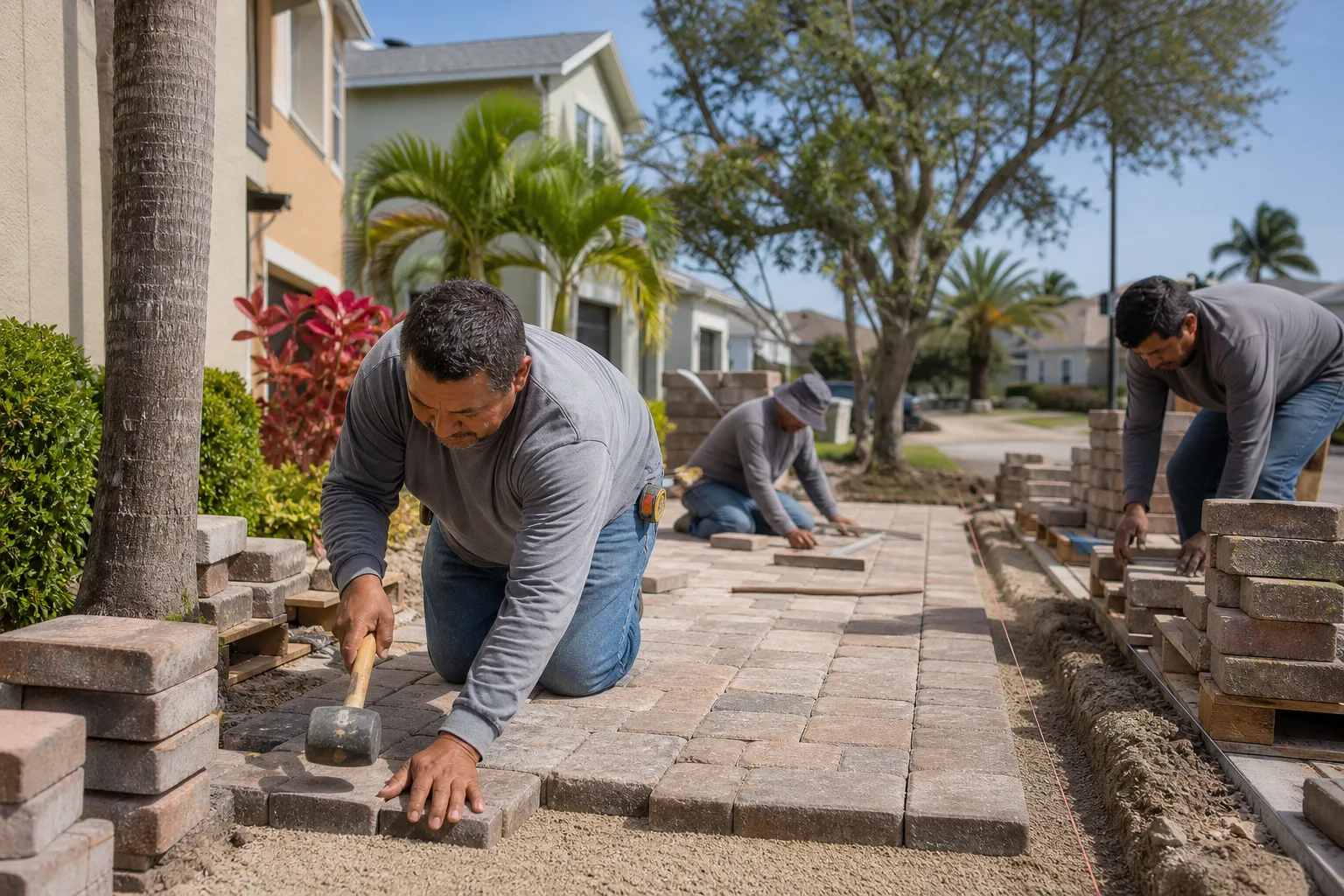
Some maintenance tasks belong with a professional. Base settling that shows as a rocking paver after a storm, an edge restraint that’s popped away from the base course, visible water tracking toward the garage slab or foundation, and any joint field that has opened along three or more rows all need a trained eye before the repair scope gets bigger. The same is true for a full reseal on a driveway over 600 square feet – the surface prep work matters more than the sealer itself, and a poorly prepped seal will haze or peel within a season. A driveway crack that has grown more than 1/4 inch wide by more than 3 feet long is also worth a professional inspection, especially on the hillside blocks above Glenoaks, where differential movement may indicate base-layer issues beyond the driveway itself.
Groundwork Construction Co. of Burbank offers free estimates in Burbank – call (844) 797-7958 to schedule a walkthrough. We’re a full-scope construction partner, which means when a driveway or paver surface needs more than maintenance – a reset, a new installation, coordinated work with a fence installation in Burbank project, or hardscape that ties into a home addition or ADU in Burbank – you’re not coordinating three contractors. Our technicians have up to 12 years of experience, and every project is covered by our 730-Day Done Right Promise. If the work isn’t right, we make it right. Material partners like Belgard sit inside the same procurement pipeline as our other trade brands, so what you get is a spec written into the estimate, not whatever’s on the pallet that week.
Frequently Asked Questions
Every 24 to 36 months for most Burbank driveways, not annually. The exact interval depends on sun exposure and shade, so test the surface with a cup of water before scheduling – if the water beads and runs off, the sealer is still working. Full sun driveways on the foothill blocks should plan on the 24-month end of that range. Call (844) 797-7958 for a free estimate on a reseal – we’ll run the water-bead test during the walkthrough.
Burbank’s specific combination of extreme summer UV, dry Santa Ana wind grit, and concentrated winter rain produces a faster failure cycle than neighboring cities. The UV oxidizes sealers and pigmented surfaces nearly year-round, the wind scours joint sand from the windward edges, and the short rainy season dumps water under the pavers faster than a compromised slope can shed it. In our experience that means Burbank driveways need the joint refill cadence run twice a year, not annually.
Expect $6 to $11 per square foot installed for a full reset – roughly $3,000 to $8,800 for a standard 500 to 800 square foot Burbank driveway. That’s the math that makes the $450 to $900 annual maintenance routine worth keeping. Call (844) 797-7958 for a free estimate and a written line-item scope before any work begins.
Spot-refilling a small section of open joints with polymeric sand is a reasonable homeowner task, and the material is not hard to source. What we don’t recommend is attempting base settlement corrections, edge restraint repair, or any work where a paver has moved more than 1/4 inch underfoot – those involve load-bearing layers. Call (844) 797-7958 for a free estimate if you’re not sure which category your driveway falls into.
Interlocking concrete pavers with a written color-fade warranty of 10 years or more are the most reliable choice for a Burbank driveway. Clay brick pavers work well for aprons and borders but are more brittle under point loads, and natural stone is beautiful for walkways but a poor choice for vehicle traffic in this sun. Imported pavers under 2-3/8 inches thick are the material we see fail fastest in Burbank’s seasonal swings.
Yes – the Santa Ana wind cycles are the biggest driver of joint sand loss in Burbank driveways. Those dry offshore gusts carry fine grit from the foothills that acts like sandpaper in the joints, and the windward edge of a driveway will often lose 1/4 inch or more of sand in a single fall season. Inspect the perimeter of your driveway within 48 hours of any major wind event and spot-refill as needed.
The Bottom Line
Driveway and paver maintenance in Burbank isn’t complicated – it’s just timed to the local climate instead of a generic manufacturer schedule. Two inspections per year (spring and fall), one seal cycle every 24 to 36 months, and a joint sand refill cadence that accounts for the Santa Ana wind cycles together cost $400 to $900 per year and prevent the $3,000 to $8,800 resets we see on driveways that skipped those visits. Burbank’s UV, wind, and rain pattern is a well-documented failure sequence, and it’s completely manageable once you know what to look for. Our technicians have up to 12 years of experience in this climate and are background-checked and uniformed on every job; every project we perform is covered by the 730-Day Done Right Promise. If you’d like a written walkthrough of what your specific driveway needs, start with our team at Groundwork Construction Co. of Burbank home.
Groundwork Construction Co. of Burbank offers free estimates across Burbank – call (844) 797-7958 to schedule yours. Calls are answered by a live person 24/7, the estimate is free and itemized in writing, and we don’t send a crew until you’ve approved the scope. From a spring joint refill to a full paver reset, every job we take on is covered by the 730-Day Done Right Promise, and our upfront pricing means the number on the estimate is the number you pay. Whether you’re on a hillside block above Glenoaks or a flat lot in Magnolia Park, we can walk your driveway and tell you exactly what it needs – call us today to get on the schedule before the spring sealing window closes.
Written by the team at Groundwork Construction Co. of Burbank.